Reclaim your freedom and rediscover your life
Expert care in prosthetics and orthotics. Designed to restore movement, comfort, and confidence at every stage of your journey.
Years of
combined
experience
In house
Prosthetics
Services
Proven
Patient
Success
In house
Orthotist
Services
Compassionate
Treatment
Approach
Discover a new level of Prosthetic Care & Rehabilitation
The Orthotic & Prosthetic industry is a wide and diverse field. We offer a wide variety of standard and custom Orthotic and Prosthetic products, devices, assistance, management and help.
Get In Touch
Our Services
01
Custom
Prosthetics
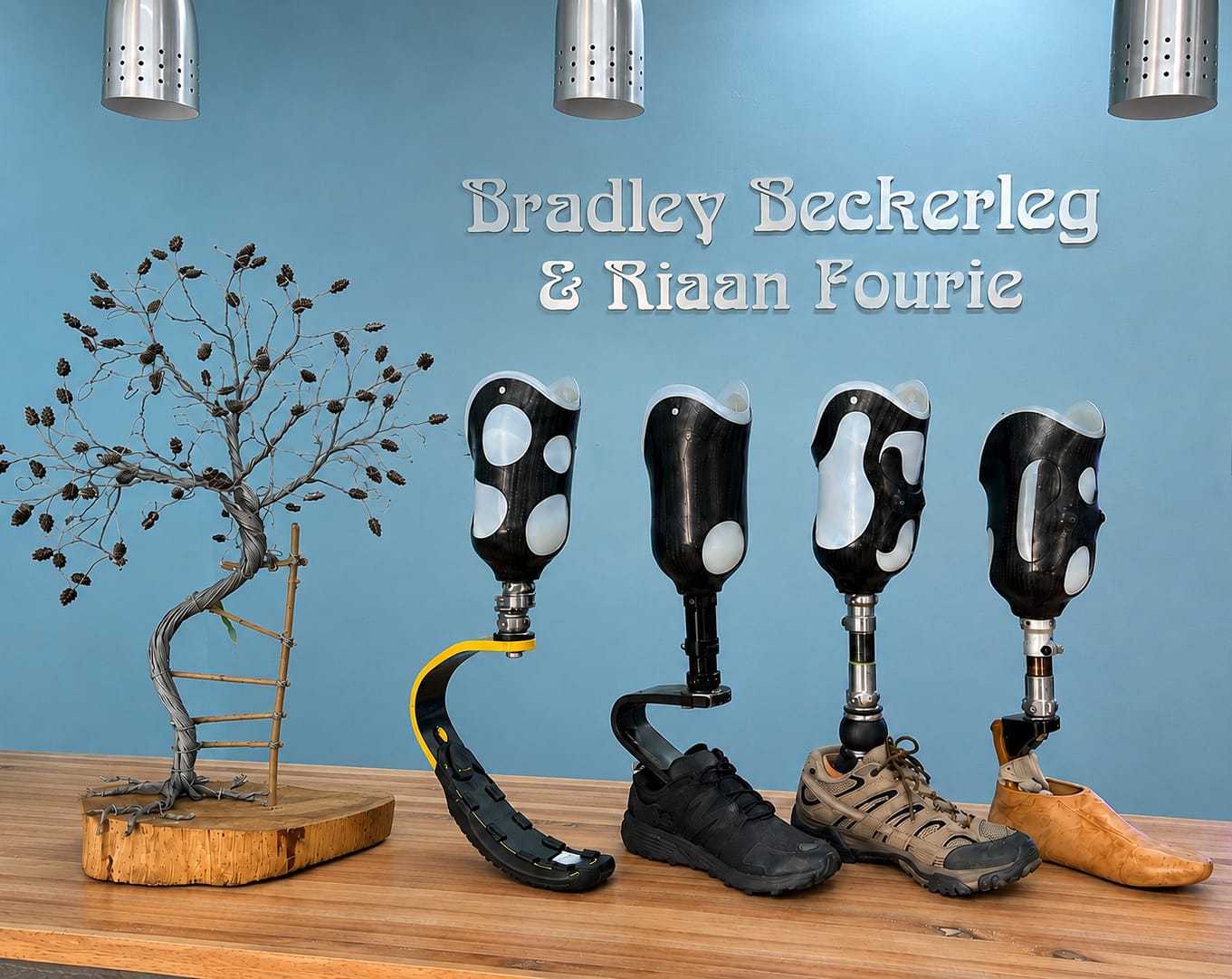
Custom-designed for comfort and functionality:
- Lower Limb Prosthetics
- Breast Prosthetics
- Osseointegration
02
Custom
Orthotics
Custom-designed for comfort and functionality:
- Lower Limb Orthotics
- Upper Limb Orthotics
- Spinal Orthotics
03
Off-the-shelf
Items
Custom-designed for comfort and functionality:
- Leg Prostheses
- Arm & Hand Prosthetics
- Paediatric Prosthetics
04
Compression
Therapy
Compression garments for healing and comfort.
- Tailored Treatment Plans
- Compression Garments
- Optimal Support
Success Stories
A trans-tibial (below-knee) amputee with a fused knee faced the challenge of a straight, non-bending leg. Our team designed a custom prosthesis with a manual locking knee, enabling him to bend his leg when seated, especially useful for taxi travel. A split cosmetic cover preserved both function and natural appearance.
Diagnosed with Guillain-Barré 20 years ago, Zane was left with lasting weakness in his arms and legs. Determined to keep providing for his family, he endured years of pain and fatigue while walking. After receiving custom laminated jointed AFOs, his balance and gait improved dramatically. Today, Zane walks confidently, works actively, and lives independently again.
After a devastating 2017 motorcycle accident left Liezl paralysed, doctors said she’d never walk again. Refusing to accept that, she fought relentlessly through years of rehabilitation. From a wheelchair to walking with braces, then without any support. Her unwavering determination proved everyone wrong. Liezl’s persistence turned impossibility into triumph.
When Buti joined us, she struggled with mobility and longed for independence. Through a personalized rehabilitation plan and her unwavering determination, she mastered her new prosthetic and regained confidence. Today, she walks independently and enjoys active weekends with her family. A true story of strength and renewal.
Case Studies
Real journeys from our practice — from the very first fitting to the day life opens back up. Follow each patient’s story, one step at a time.
A locking knee that bends for everyday life
Trans-tibial (below-knee) amputee with a knee arthrodesis (stiff knee). The unique challenge of a straight, non-functional knee was overcome by incorporating a manual locking knee into the below-knee prosthesis. This allowed the patient to bend the leg whilst seated — of particular importance when travelling in a taxi. The cosmetic cover was split to allow functional movement.

A flexible socket built for an active young life
Trans-tibial (below-knee) prosthesis for a young, active amputee who lost his limb in a work-related incident. A flexible inner socket with a framed cage was used for optimal comfort. His limb was finished with a soft cosmetic cover and cosmetic stockings — an affordable cosmetic option, with the stockings replaceable as required.

Zorro: a no-boundaries attitude, 15 000 steps a day
Zorro is a bit of a legend in the practice — a bilateral amputee with a no-boundaries attitude. From running to jumping and a generally very active lifestyle, Zorro covers on average between 10 000 and 15 000 steps per day — more than most people in general, let alone bilateral amputees.

Oom Piet: still working full-time at 75
Oom Piet has been an amputee for four years now. He is an extremely active 75-year-old who still holds a full-time position in sales management — a testament to perseverance and a never-give-up attitude.

Mr Noble: remarkable progress in just six months
Mr Noble was amputated a mere six months before these images. The first picture shows the residuum three weeks after amputation; the second shows the same limb three weeks after the coning period. Mr Noble has severe volume fluctuations of his limb, yet despite this has attained remarkable rehabilitation milestones in a very short period. His prosthesis is suspended with a silicone cushion liner and over-sleeve to create a full vacuum, and is easily donned and doffed. The prosthesis is still in the diagnostic (trial) phase; the next step will be the definitive (final) prosthesis.

Thabang: positivity from day one
Thabang was welcomed into our practice in 2018 following a tragic accident in which he suffered the traumatic loss of his right leg below the knee and his left leg through the knee. Thabang has done well since day one, with a positive attitude and a keen outlook on life — a positivity that we could and should all strive for.

Amputations are not age-dependent
Amputations are not age-dependent. This brave soldier underwent a knee disarticulation (through-knee amputation) at a few months of age. Her initial prosthesis was kept simple, with a basic silicone suspension system, pylon and foot. We are looking forward to fitting her first articulated knee in the next few months — watch this space.

JP: a prosthesis tailored to the finer things in life
A truly unique amputee with very unique requests. JP has overcome many of his challenges in life, including being a new trans-tibial (below-knee) amputee. He still enjoys a few of the finer things in life and requested a prosthetic addition that would make his social life a little easier — we gladly obliged.

A carbon-fibre cover that zips on for any occasion
Another rock-star patient who has endured a lot in life. This dynamic lady has the desire to blend into society when required, yet likes having a prosthesis that can be — and often is — the focus point of conversation. The carbon-fibre cover can be easily zipped on and off, as and when she requires.

Testimonials
“I lost my left leg below the knee in 2016. I am now fully active with my prosthesis. What I learned with Bradley Beckerleg & Riaan Fourie and Team which assisted me is that everyone has their role. From reception, fitting and manufacturing to finance, it supported me with more passion than I could ever have anticipated. These are people who care.
Mr Van Der Wissel
“I have been a patient of Bradley Beckerleg & Riaan Fourie for the past six years now and I am happy with their services and I can recommend to anyone who needs assistance with anything that the practice offers. They are my second home and whenever I need assistance, they are a phone call away.”
Thembi
“My name is Thabang Moloto, I want to thank Bradley for his amazing work. I have always appreciated my prosthesis I received from the practice, because I am always happy, and I am feeling much better now. It was like I never had an accident before this. Thank you, Bradley, and Team.”
Thabang Moloto
News Board
One of the first questions after amputation, right after “when can I walk again,” is
What You Should Know Before Getting a Prosthetic Leg Most people who lose a limb
The Experts
Bradley Beckerleg, founder and Chief prosthetist of Bradley Beckerleg and Riaan Fourie.
Riaan Fourie, Chief Orthotist and senior colleague
LINKED IN
Certified Medical Orthotist and Prosthetist
LINKED IN
LINKED IN
LINKED IN
Frequently Asked Questions
Are you a new Amputee? We are here to help.
How long will my prosthesis last?
Are Bionic limbs available?
Is it difficult to use prostheses?
Will I need a wheelchair or crutches?
What can I do to prepare myself for prothesis?
Reducing Swelling:
Swelling must be minimized before prosthesis fitting, often using elastic garments called shrinkers or post-operative silicone liners to shape the limb. These shrinkers will be provided to you by your prosthetist and need to be used as instructed by them. Once you start wearing your prosthesis the use of additional compression garments should not be necessary.
Preventing Contractures:
Proper limb positioning is crucial to prevent muscle shortening known as contractures. Ensure that your limb is positioned correctly as much as possible. For trans tibial: avoid as much as possible long position with a knee flexion (cushion under the knee for example) For trans femoral: avoid position with hip flexion and abduction (cushion under the stump for example).
Desensitizing the Skin:
The skin of the residual limb may be sensitive initially. Techniques like massage and tapping help gradually increase tolerance to touch which will make the fitting of the prosthesis easier.
Preventing Skin Problems and Infection:
Daily hygiene is essential; the limb should be washed with warm water and soap and kept dry to prevent infections. Sheer forces and rubbing with your prosthesis and compression wear are your biggest challenge and your residuum needs to be continually evaluated.
Rehabilitation:
Physical therapists can help you to strengthen your muscles to allow you to have better control over your prosthesis. Your prosthetist will be actively involved in your initial mobilisation and will refer you for advanced gait training and assessment. Psychotherapists can often be extremely beneficial. The trauma associated with limb loss is often overlooked, and successful prosthetic rehabilitation is dependent on the acceptance off the amputation and associated trauma.
Funding Support
Navigating medical aid and support programmes
We understand prosthetics and orthotics can be costly. That’s why we help you explore funding options. From medical aid to support programmes — making access easier and less overwhelming.


